
Yalobusha Parole and Probation Compared
Mississippi uses several labels for people under control in the community. Parole is a conditional release from an MDOC prison term. The Mississippi State Parole Board grants it after eligibility review, and the grant is discretionary. Probation is ordered by a court. It can replace or suspend part of a sentence, so probation does not establish that the person ever served a prison term. Earned-release supervision, or ERS, permits an eligible person to leave an institution while retaining inmate status under MDOC through sentence expiration.
Post-release supervision is another court-ordered part of a sentence. Intensive Supervision Program placement, often called house arrest, adds electronic monitoring and tighter community limits. These statuses may all involve MDOC Community Corrections, but they do not mean the same thing. Read the source label exactly.
| Status | Who authorizes it | What it establishes |
|---|---|---|
| Parole | Mississippi State Parole Board | Conditional release from an MDOC prison sentence |
| Probation | Sentencing court | Community sentence that may exist without prison |
| ERS | MDOC under state law | Physical release while inmate status and MDOC jurisdiction continue |
| Post-release supervision | Sentencing court | Community control imposed as part of a sentence |
| ISP | Authorized corrections or court process | Intensive community limits, often with electronic monitoring |
- Discharge
- The formal end of the applicable sentence or supervision term.
- Absconder
- A person reported to have stopped required contact with supervision. The label must come from the responsible authority.
- Revocation
- An official action that can cancel community release and return a person to custody.
Check Yalobusha Post-Release Supervision
The official Mississippi Parolee Search is the direct public starting point for parole. It accepts a name, MDOC number, city, county, and other live filters. Select Yalobusha when the county filter helps narrow a match. That county field likely reflects residence or supervision location, not necessarily the county of conviction. An MDOC number is more precise than a name.
Parolee Search does not cover every released person. It may omit probation, ERS, completed supervision, a county-only bond release, and people whose supervision status is inactive or no longer public. Use the result as one agency record, then confirm the specific status.
- Search by MDOC number when known. Otherwise enter the legal name, then a documented name variant.
- Compare more than the name. Use identifiers and the county, city, status, or location fields shown by the live record.
- Record the exact supervision term and the date checked. Do not convert parole, probation, ERS, or inactive into a different label.
- Call the Yalobusha Probation and Parole Office with the MDOC number and ask what information can be confirmed.
- For probation or post-release supervision, obtain the sentencing, modification, revocation, or discharge order from the proper court.
The broader Yalobusha County released inmate search explains how to separate a county-jail release from an MDOC discharge or transfer. That distinction matters because a county booking can end without any state supervision record.
Start with the document that created the status. A Parole Board action supports parole. A Yalobusha sentencing order supports probation or post-release supervision. An MDOC record supports ERS or current corrections placement. If a Yalobusha jail booking ended through bond, dismissal, time served, or a local sentence, the sheriff's jail docket may be the only release trail and the state parolee tool may have no role.
When records disagree, note the custody episode and date attached to each source. A court order can be older than a later revocation. An MDOC location change can post after the event. A jail departure can occur before a state intake record appears. Ask the agency that owns the disputed event for a timestamped record instead of choosing the source with the newest-looking web page.
Yalobusha Parole Office Confirmation
MDOC Community Corrections maintains a county-specific office in Water Valley. Its page does not publish office hours, walk-in rules, an officer list, or a promise that staff will disclose case details by phone. Call before visiting. Give staff the MDOC number when available and ask what record or written process can confirm the status.
Yalobusha Probation & Parole Office
1072 County Road 436
Water Valley, MS 38965
Mail: PO Box 616
Phone: 662-473-3310
Fax: 662-473-1636
Hours: Not published
The official Yalobusha office listing shows the local address and telephone details. The captured office page below is useful for finding the correct MDOC contact, but an office listing alone does not prove that any named person is supervised there.
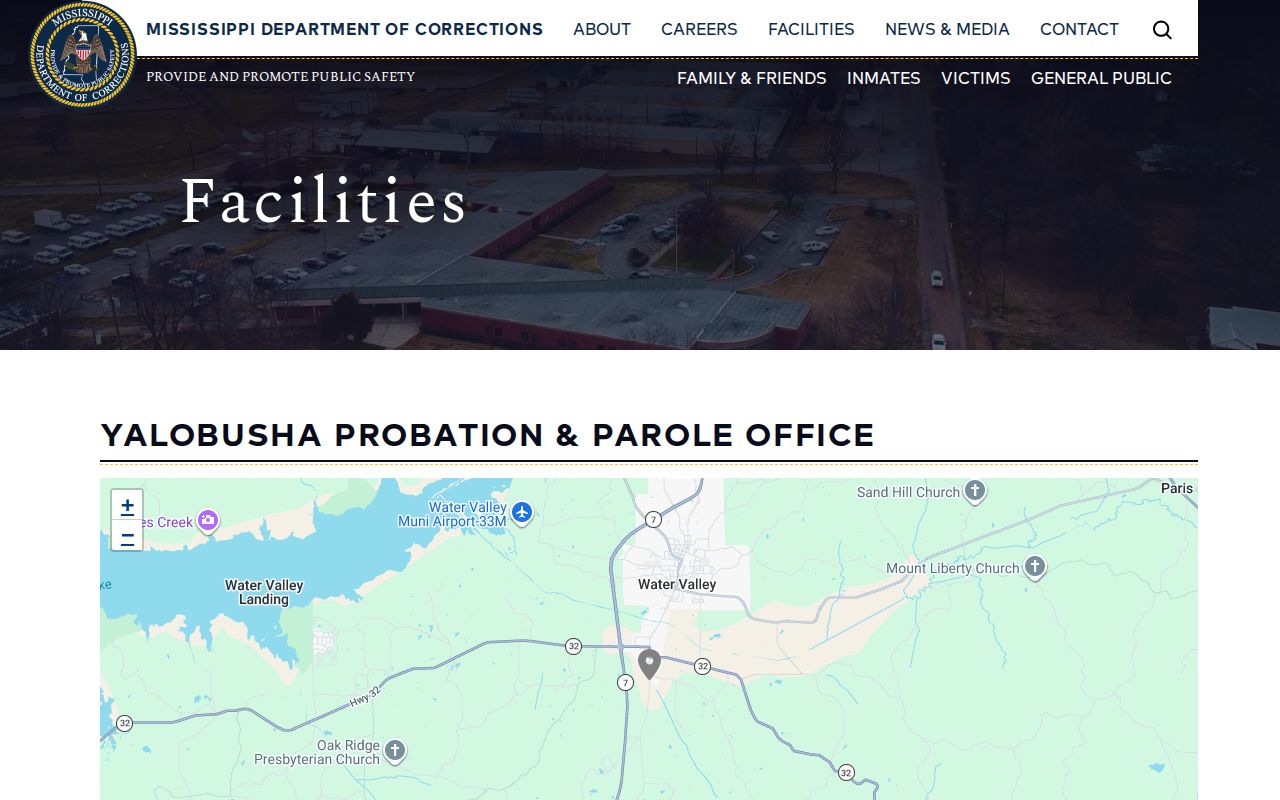
Use the contact details to confirm procedure, then rely on a person-specific state result or court record for the actual supervision finding.
Mississippi splits authority. The Parole Board decides parole grants and revocations, while MDOC calculates eligibility and provides field supervision. A probation sentence comes from the court. Asking the local office to prove a Board decision or court judgment may require a written record from the agency that issued it.
Yalobusha Supervision and Violations
Community supervision can require reporting, approved residence, travel limits, payment or treatment obligations, and other person-specific terms. The governing order and MDOC instructions control. General descriptions cannot establish one person's conditions. Parole or ERS may also require residence approval before release, so an estimated prison date does not prove that a community placement is complete.
No official statewide MDOC absconder list or Yalobusha County public warrant list was verified in the research. A person who misses required contact may be classified as absconded and may face a warrant or return-to-custody action. Still, an absent search result cannot support that label. Confirm through MDOC, the Parole Board, the sentencing court, or the authority that issued a warrant.
Mississippi SAVIN may report an absconded-supervision or return-to-custody change when its source agency supplies that event. A notification is a prompt to verify, not the warrant itself. Court revocation records can show what the judge ordered, while MDOC or Board records show corrections action.
Residence and travel rules also affect how a community status is read. MDOC describes residence approval as part of parole and ERS planning. A person may be outside an institution but subject to an approved address and reporting schedule. Interstate Compact supervision can place a Mississippi case under field supervision in another state, so a local Yalobusha result may not show every current contact detail.
Note: Preserve the agency's exact status and check date because community supervision can change without a matching change in every public tool.
Yalobusha Reentry After Release
The local Community Corrections office is more than a point on a statewide search map. It is the named supervision office for Yalobusha County. MDOC also documented grant-supported reentry services reaching Yalobusha for people returning with substance-use or mental-health needs. That local layer can help a person navigate supervision and care, but it is not a public release record.
Read the MDOC reentry expansion notice for the program context. Availability, qualification, referral, and current service details should be confirmed with MDOC. Do not treat program contact as proof that someone left custody or remains on supervision.
This distinction is useful in Yalobusha County. A person may seek local services after a prison release, a jail release, or a court-based sentence. Only the corresponding MDOC, jail, or court record identifies the legal path.
Yalobusha Supervision Final Discharge
Physical release and final discharge are separate events. Mississippi Code § 47-7-40 allows earned-discharge credits for compliant people on probation, parole, or post-release supervision. When time served plus authorized credit satisfies the term, the Board or sentencing court orders the final discharge. The order is stronger proof than a name that no longer appears in a public search.
A missing parolee record can have several meanings. Supervision may be complete, the person may have moved, the record may be inactive, the search input may differ, or public display may have changed. Ask for the discharge order or releasable agency confirmation. If facts conflict, the issuing court controls a probation discharge, and the Board or MDOC record controls the applicable parole action.
The Mississippi State Parole Board provides the Board route for policy and records navigation. There is no verified public current-decision calendar or searchable decision portal, so a person-specific action may require direct inquiry or a records request.
Mississippi's Public Records Act provides a route when a releasable supervision or discharge record is not online. Under § 25-61-5, an agency may use reasonable written procedures and must state a precise exemption in a written denial. Exempt material should be redacted where possible so the remaining public record can be produced. Section 25-61-7 limits advance charges to actual search, review, duplication, and mailing cost. Ask for an electronic copy in the format the agency maintains when that will reduce work.
A focused request should name the person, MDOC number, date range, and exact item, such as a parole action, final discharge order, or public supervision-status record. Do not ask the local office to create an explanation it does not keep. A narrow record request makes it easier to distinguish a release from prison, the period under community control, and the later date of complete discharge.
Note: A final discharge ends the specified supervision term, but it does not rewrite the separate county jail docket, conviction record, or court history.