
Yalobusha Release Date Meanings
Mississippi Department of Corrections uses the exact public label Tentative Release Date. It is a computed estimate, not a certificate that a person left custody. MDOC separately calculates parole eligibility, earned-release supervision, tentative discharge, and maximum dates. A date can move while staff apply sentence credit, statutory eligibility, forfeiture, consecutive terms, detainers, or release-plan requirements.
The actual release date records a completed custody event. Even then, the event may be parole or ERS rather than final discharge. A person can be outside a prison and still remain under MDOC jurisdiction. County jail releases follow another record path: the Yalobusha sheriff's jail docket must state how the prisoner was released or discharged and retain the supporting release warrant or penitentiary receipt.
A pretrial county detainee does not have a sentence-based release date. Bond, a judge's order, dismissal, transfer, or case disposition determines what happens next. A bond amount or hearing date is not itself a release timestamp.
People held for another authority need one more check. A county jail may release a booking to MDOC, another county, federal custody, or immigration authority. That event ends the Yalobusha jail stay but does not start life in the community. Ask the jail for the recorded manner of discharge and the receiving custodian before relying on any projected date from another system.
Find Yalobusha Projected Release Dates
Begin with custody type. A person held only at the Yalobusha County Detention Center is not made into an MDOC prisoner by the fact of a county booking. Conversely, a Yalobusha conviction does not mean the person remains at the county jail. MDOC can assign a state prisoner anywhere in its system.
- Call the Yalobusha jail at 662-473-2722 when the person is a county detainee. Ask whether the person remains there and whether the booking has an ordered or computed end.
- Check the sentencing court for the judgment, sentence structure, jail credit, later orders, and any bond or release authority. Yalobusha has two judicial districts, so use the correct court and district.
- For a state sentence, search the MDOC inmate search by MDOC number or name. Open the detail page.
- Compare date of birth, physical descriptors, offense, sentence date, county of conviction, current location, and entry date before relying on the Tentative Release Date field.
- When the date must be exact, request the public portion of the MDOC time sheet, actual release or discharge date, release type, discharge certificate, and applicable parole action.
The Yalobusha County released inmate lookup gives the broader route for someone who may already have left physical custody. For this date question, stay with the agency that owns the sentence. A BOP sentence uses the federal locator, while an immigration detention episode uses ICE rather than MDOC.
Yalobusha court records are split by case level and judicial district. Justice Court may hold an initial appearance, county misdemeanor, DUI, or bond record. Circuit Court and its clerk preserve felony judgments and sentences. Water Valley or Coffeeville Municipal Court may control a city case. If the jail confirms a booking but one clerk finds nothing, verify both the court level and the district before concluding that no order exists.
Note: County of conviction and current location answer different questions, so never treat “Yalobusha” in one MDOC field as proof of county-jail custody.
Yalobusha MDOC Release Date Field
An MDOC detail record can display the name and MDOC number, photograph, birth date, physical descriptors, entry date, location and unit, location-change date, sentence totals, offenses, sentence dates, and county of conviction. The tentative field appears near the bottom. A result row alone is not enough; open the full detail and verify identity.
| MDOC field | How to read it |
|---|---|
| Tentative Release Date | Current estimate subject to state law and later changes |
| Location | Current MDOC placement or supervision-related value, not county of conviction |
| Location change date | A placement update, not automatically a release |
| Sentence blocks | Offense, term, sentence date, and county used in the computation |
| Entry date | MDOC entry information, not necessarily the sentence-begin date after credit |
The official MDOC example detail shows the exact Tentative Release Date label. The capture below demonstrates the field format, not a Yalobusha County subject.
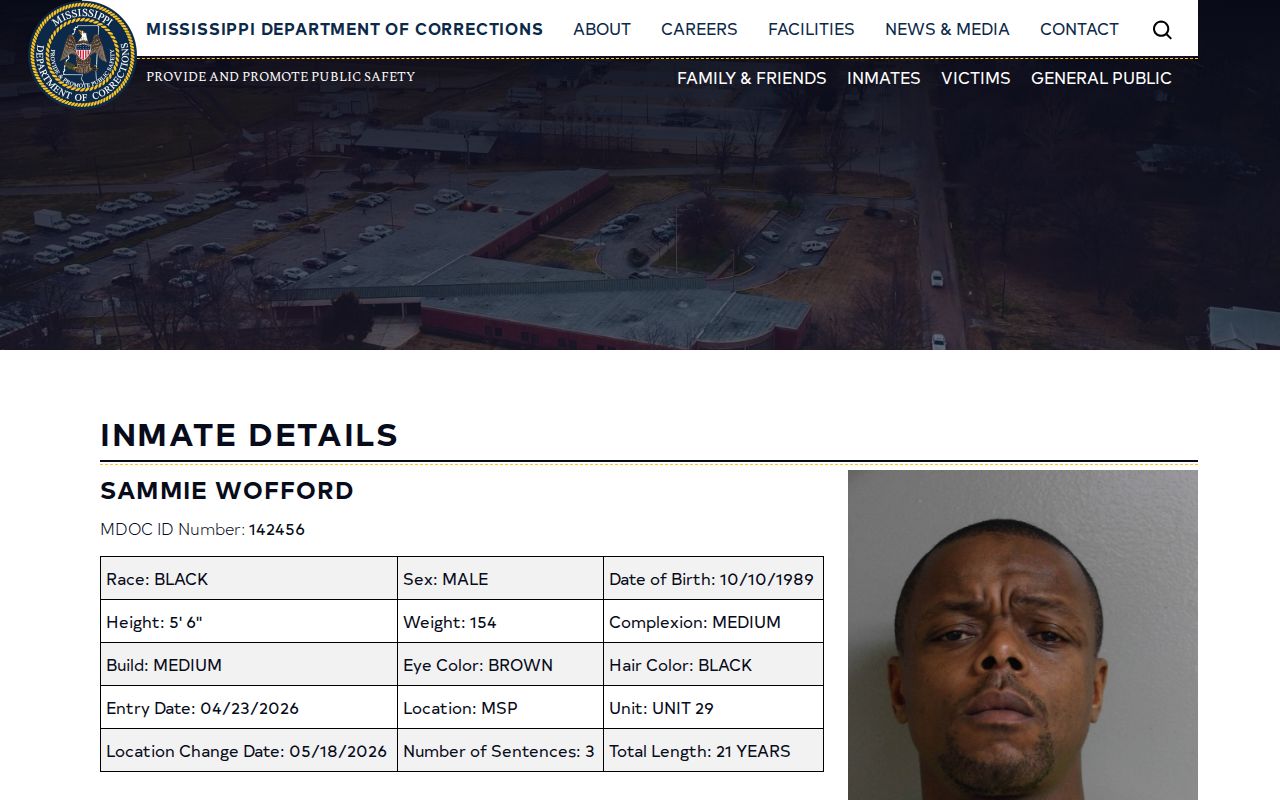
Match the public estimate with the person's own sentence record. MDOC warns that actual release types and dates can differ from online information.
Yalobusha Earned Release Computation
Mississippi's state calculation begins with the sentence structure and eligible pre-sentence county jail credit. The MDOC handbook says eligible jail time is deducted from the earliest sentence date to establish the sentence-begin date. Simply adding the pronounced term to the sentencing date can therefore be wrong. Consecutive sentences, mandatory terms, and offense-specific rules add more layers.
Under Mississippi Code § 47-5-138, an eligible sentence imposed after June 30, 1995 can receive earned time up to 15 percent. This creates the often-used 85 percent institutional and 15 percent ERS illustration. It is not a rule that every Mississippi prisoner is released after exactly 85 percent. ERS remains discretionary, and the participant keeps inmate status under MDOC until sentence expiration.
Section 47-5-138.1 permits additional trusty earned time for eligible prisoners, subject to exclusions. Section 47-5-142 authorizes meritorious earned time for qualifying work or program achievement and permits written forfeiture. Habitual status, sex offenses, specified violent offenses, mandatory portions, and other exclusions can limit these paths.
Credits affect the calculation only when the statute and sentence permit them. A program completion or trusty assignment should not be converted into a new release date without the MDOC computation. Likewise, a disciplinary event should not be assumed to have caused forfeiture unless the department's record shows that written action. The time sheet is the practical place to reconcile the sentence, credited custody, awards, losses, and current estimate.
- Jail credit
- Eligible time spent in custody before the state sentence begins.
- Earned time
- A statutory credit available only when the person and sentence qualify.
- ERS
- Earned-release supervision outside the institution while MDOC inmate status continues.
- Maximum date
- The sentence endpoint calculated without treating an earlier eligibility date as guaranteed release.
Why Yalobusha Release Estimates Shift
Yalobusha County cases expose a key computation issue: the public date is only one output from several internal calculations. Eligible jail credit may move the sentence-begin date. Earned, trusty, or meritorious credits may affect the estimate, but written forfeiture can remove credit. ERS eligibility does not ensure approval, and an approved residence can be required before departure.
| Factor | Possible effect | Best confirmation |
|---|---|---|
| Pre-sentence jail credit | Changes the sentence-begin calculation | Sentencing record and MDOC time sheet |
| Earned-time award or loss | Moves an eligible tentative date | MDOC computation record |
| Consecutive or amended sentence | Adds time or changes sentence structure | Court judgment and later orders |
| Detainer or outside hold | May prevent community release or cause transfer | Holding agency and jail or MDOC |
| Parole decision | Can open conditional release but does not set the physical timestamp alone | Parole Board action and MDOC |
| Residence or travel-plan approval | Can delay parole or ERS processing | Case manager or Community Corrections |
The MDOC Family and Friends Guide says parole or ERS eligibility is not guaranteed release, the case manager supplies the exact date, and travel plans must be verified. It also says processing may take 30 to 45 days and the person must receive a discharge certificate. Those details explain why the public tentative field should not be used as a pickup appointment.
For a county-jail-only sentence, no Yalobusha County good-time formula was verified. Ask the jail and sentencing court for the time computation, jail credit, sentence start and end, and release authority. Do not apply MDOC's state formula to a county commitment.
Detainers require special care. A detainer is a notice that another authority wants custody or action. It can affect where a person goes when the current term ends. The tentative date may still mark progress in the present sentence while the detainer blocks an ordinary community release. Confirm the hold with both the present custodian and the agency that lodged it.
Release planning can create a delay without changing the underlying sentence. MDOC says a case manager verifies the exact date and travel plan. Residence approval can matter for parole and ERS, and processing can continue after eligibility is reached. The correct question is therefore not only “what date appears online?” but also “which approvals and holds remain before physical release?”
Yalobusha Parole Eligibility Dates
Parole eligibility is a separate calculation under Mississippi Code § 47-7-3. Current principal thresholds described in the research vary by offense class, sentence date, and statutory limits. Qualifying post-1995 nonviolent sentences can reach eligibility at 25 percent or ten years, whichever is less. Certain violent offenses use 50 percent or twenty years; armed robbery, drive-by shooting, and carjacking use 60 percent or twenty-five years. Qualifying nonhabitual drug offenses may use 25 percent or ten years.
Those are eligibility points, not promised releases. Habitual, sex, capital, trafficking, mandatory-term, and other exclusions may control. The Parole Board decides whether to grant parole, while MDOC calculates eligibility and handles later processing. A grant still differs from the physical release time.
Active Yalobusha County parole or probation must be confirmed through the appropriate state supervision record, local office, and final discharge order after a person leaves prison.
Confirm Yalobusha Actual Release
Use the projected date to plan a later confirmation, not to declare that release occurred. For an MDOC prisoner, check the detail again, then seek the time sheet, actual release or discharge date, release type, parole action, and discharge certificate when needed. For the Yalobusha jail, ask for the statutory jail-docket entry and its release warrant or penitentiary receipt.
VINELink can send a reported release or transfer alert when the source agency participates and the correct record supports registration. A VINELink change reflects the reporting agency's update. It does not state every legal reason or rule out another custodian. Use the VINELink Release Check to set and verify that notification path.
If the online date is unclear, Mississippi public-record procedures allow a focused request for an existing releasable record. Identify the full name, MDOC number, sentence or case, and date range. Ask for the public time sheet and actual release or discharge record, not a new calculation prepared for the requester. Fees may cover actual search, review, duplication, and mailing cost, and exempt details can be redacted while the rest is produced.
Note: A transfer to MDOC, another county, federal authority, or immigration custody is a change of custodian, not a community release.